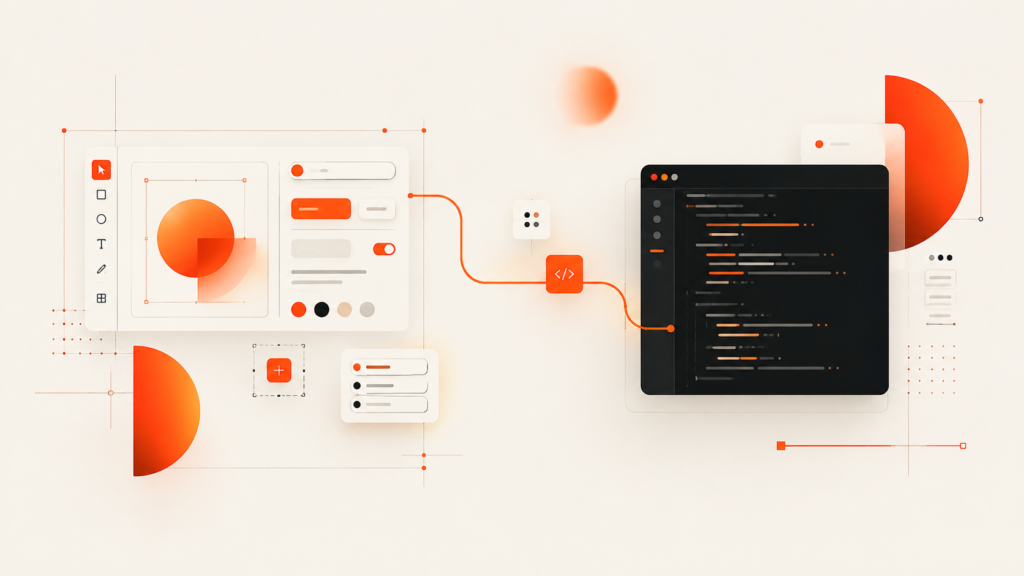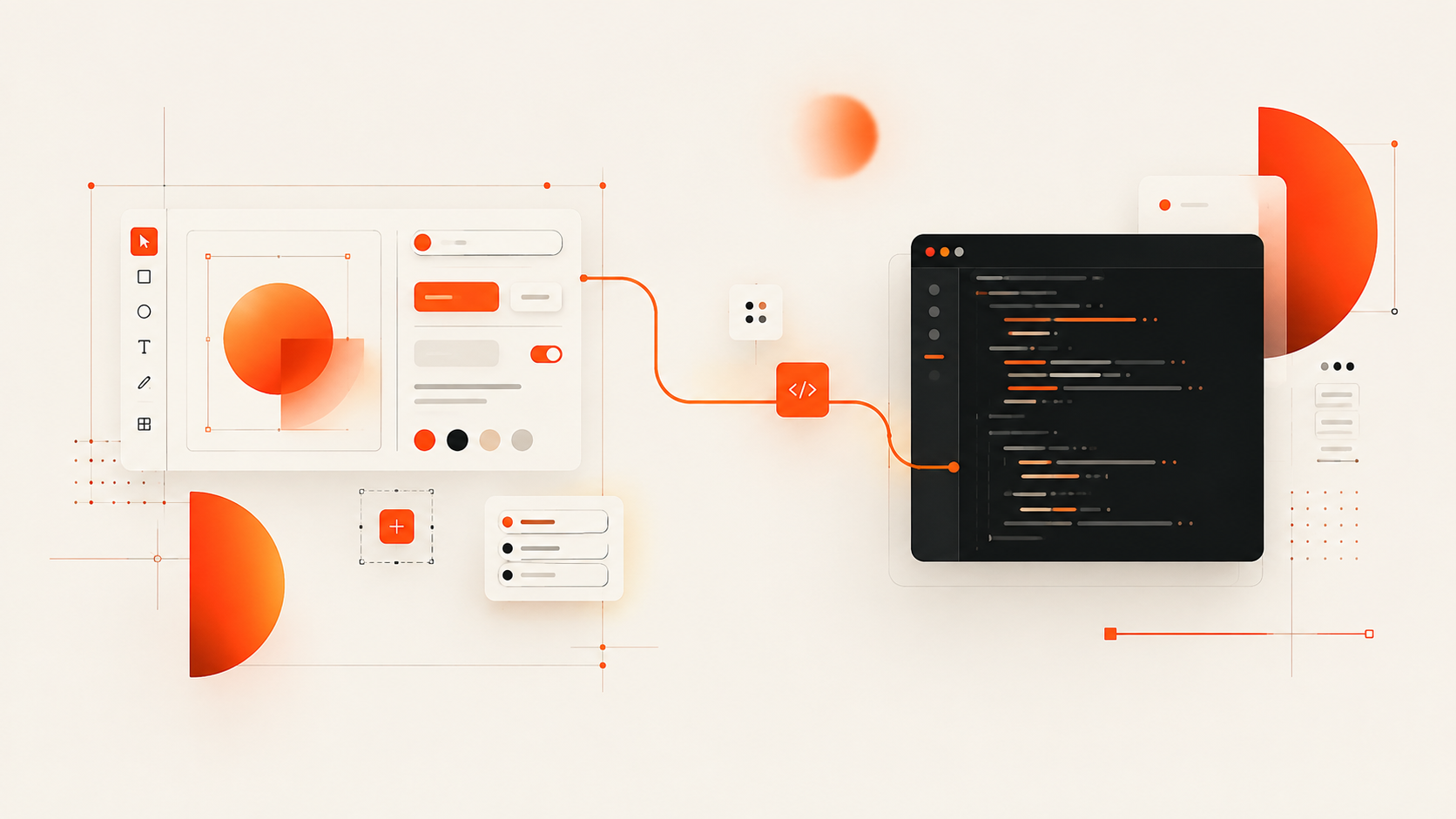
Every product team pays a tax nobody puts on the budget. It shows up as a week lost between “design approved” and “build started.” It shows up as a button that shrinks by four pixels, a spacing value that quietly becomes “close enough,” a hover state nobody built because the ticket never mentioned it. Multiply that across a dozen features a year and you get a product that looks different in every screenshot than it does in the browser.
That is the handoff tax. Most teams have accepted it the way you accept traffic on the way to work, as the cost of doing business. It is not the cost of doing business. It is the cost of splitting design and development into two jobs that never learned to speak the same language.
The fix is not a better handoff process. It is designers who do not need to hand off at all.
The design handoff tax: where time and fidelity leak
Watch what actually happens to a design between Figma and production. A designer builds a screen with precise spacing, a considered type scale, and states for every interaction. That file gets exported, described in a ticket, and picked up by a developer who is reading intent instead of seeing it. Every step in that chain is a place where information gets lost.
The developer is not careless. They are translating, and translation always loses something in the crossing: the hover state that never got documented, the empty state nobody designed, the way a headline should wrap on a narrow screen. Each of those gaps becomes a Slack message, a revision round, or a week added to a two-week sprint.
Add it up over a year and the handoff tax stops being measured in hours. It is measured in the products that shipped compromised because the fifth revision round never happened, the fidelity that quietly eroded because nobody had time to fix it, the designer who stopped trusting engineering to get the details right, and the engineer who stopped trusting design to understand what could actually be built on a two-week timeline.
That last part is the real cost. Once a team stops trusting the handoff, every project slows down to compensate for it, whether or not anyone says so out loud.
None of this is abstract. A feature that should take two weeks stretches to three because of one missed hover state. A landing page that took a day to design takes another day and a half to get pixel accurate in code. On a five-person product team, that difference is not a rounding error. It is a third of a sprint that never shows up on a velocity chart, because nobody labels it “handoff tax.” They just call it Tuesday.
What a UI/UX engineer actually does, day to day
A UI/UX engineer is not a designer who occasionally opens VS Code. It is someone who thinks in two systems at once: the visual system and the code that renders it.
In practice, that looks like this. They design in components, not screens, because that is how the interface will actually get built. They set color, spacing, and type as variables before they touch a single pixel, because they know those values need to survive the trip into a design token or a CSS variable unchanged. When a static frame cannot show what actually needs to get built, a transition, a loading state, a responsive breakpoint, they prototype it in code instead of describing it in a comment.
Most of the work is still design. The research, the structure, the actual decisions about what a screen should do for a user, none of those changes. What changes is the last mile. Instead of writing a spec and hoping it survives translation, a UI/UX engineer can open the repository, wire up the component, and watch the real thing render in a real browser. When something looks wrong, they can open the CSS and fix it themselves instead of filing a ticket and waiting for the next sprint.
That is not a designer doing engineering’s job. That is a designer closing the one gap that costs every team the most time, on every project, without exception.
Three skills to learn first
You do not need a computer science degree to close the handoff gap. You need three specific skills, learned in this order.
Semantic HTML and CSS. Before you touch a framework, learn what a browser actually does with a button element versus a styled div, and how CSS actually cascades. This is the skill most designers skip, and it is the one that matters most, because it is the language your Figma file gets translated into whether you write it yourself or not.
Design tokens. Learn to define color, spacing, and type as named variables instead of raw values, and learn how those variables map to code, whether that is CSS custom properties, a Tailwind config, or a JSON token file. This single habit does more than anything else to make your files buildable. A file full of tokens hands a developer a system. A file full of one off values hands them a puzzle to solve alone.
Component thinking. Stop designing screens and start designing components, states, and variants. A button is not an artboard element. It is a component with a default, hover, focus, disabled, and loading state. Once you think this way in Figma, you will notice you are already thinking the way React, Vue or Tailwind CSS expect you to think.
Learn those three in order and most front-end code becomes readable within a few months, with simple components not far behind. You do not need to become a senior engineer. You need to stop needing a translator for work you already understand.
When you should not build it yourself
This is not a case for doing everything alone. There is a line, and knowing exactly where it sits matters more than crossing it.
Complex application logic, data architecture, authentication, anything with real security implications: hand that to an engineer, every time. Your value here is not in replacing that work. It is in removing the friction between your design and the parts of the build that are genuinely yours to own: layout, styling, component structure, the front end experience layer a user actually touches.
The test is simple. If a mistake would cost a user their data or their trust, that is engineering’s call, not yours to make alone. If a mistake would cost a pixel of spacing or a missed hover state, that is exactly the gap you are now equipped to close yourself. Ask yourself before every ticket you are tempted to take on alone: if this breaks, whose trust does it actually cost?
Know that line, and you become the designer engineering wants on the team, not the one they have to double check.
What this changes for hiring and team structure
For founders and hiring managers, this changes the math on early product teams. A designer who can build a working front end removes an entire handoff cycle from every feature, which on a small team can be the difference between shipping monthly and shipping weekly.
For designers, it changes what a portfolio actually proves. A case study full of screens shows what you designed. A case study with a live, working build shows what you can ship, unsupervised, without someone else finishing the job behind you. That is a different kind of proof, and it is the kind that gets a remote hiring manager to stop asking for a free trial project before they will talk seriously.
I have spent the last stretch of my own work building exactly this muscle. Design to code workflows built around agentic coding tools. Small productivity tools I built for myself that turned into real deliverables for clients: plugins, small websites, a couple of micro SaaS products. Now I am building tools for the design community, I will make those live soon. I am also contributing to some projects on GitHub. None of this replaces design. It just means the decisions I make in Figma are the decisions that actually ship, instead of the ones that get quietly rewritten somewhere between the handoff and production. Where is the gap widest on your team: between design and dev, or between product and design? I would genuinely like to know.